The Hidden World in the Cartoon: Understanding Psychological Addictions Through Illustrations
The concept of addiction is often shrouded in stigma and complexity. While we readily recognize the physical toll of substance dependency, the silent, pervasive grip of psychological addictions—to gaming, gambling, or our smartphones—can be harder to visualize and communicate. This is where the power of visual storytelling becomes crucial. The Psychological Addictions Illustrations set is more than just a collection of cartoon characters; it is a toolkit for clarity, empathy, and action. These flat vector illustrations serve as a bridge, transforming abstract behavioral disorders into relatable, understandable images that can foster discussion, education, and ultimately, healing.
The Unseen Challenge: Visualizing Behavioral Disorders
For professionals, educators, and individuals affected, one of the primary challenges in addressing psychological addictions is the lack of clear, non-threatening representation. Describing the compulsive loop of smartphone scrolling or the isolating vortex of gaming addiction with words alone can fall short. Families may struggle to understand, clients might feel their experience is invalidated, and public health campaigns can fail to resonate. The goal is to demystify these conditions, to move from clinical jargon to human connection, and to provide resources that are accessible and engaging.
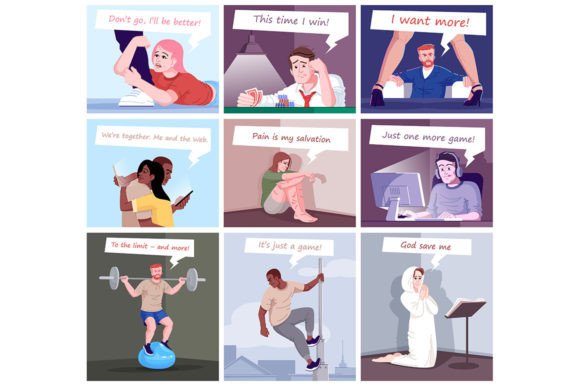
This set of Psychological Addictions Illustrations directly addresses this need. By depicting addicted people as cartoon characters in recognizable scenarios, it strips away judgment and invites understanding. The suffering is illustrated not with grim realism, but with symbolic clarity—a character glued to a glowing screen, another trapped in a virtual game controller, a third lost in a whirl of playing cards. These images create a common visual language. They allow a therapist to point to a specific illustration and say, “This is what we’re working on,” or enable a school counselor to use these visuals in a workshop without triggering defensiveness in young audiences.
Practical Applications: From Insight to Outreach
The utility of these illustrations extends far beyond simple recognition. Their design—available in versatile formats like EPS, AI, SVG, and PNG—makes them ideal for implementation across various mediums aimed at solutions and support.
Enhancing Therapeutic and Educational Materials
Mental health professionals can integrate these vectors into client handouts, progress charts, or cognitive behavioral therapy aids. For instance, an illustration of a character breaking free from a smartphone chain can be used as a visual goal marker in a treatment plan for digital dependency. In educational settings, they become powerful tools for brochures and infographic templates that explain the neuroscience of addiction in a digestible way, making complex topics like dopamine loops and impulse control accessible to a broader audience.
Building Public Awareness and Digital Resources
Public health organizations and advocacy groups require compelling content to cut through the noise. These illustrations are perfectly suited for mobile app screen pages within wellness or recovery apps, serving as intuitive icons for tracking triggers or celebrating milestones. They can form the core of social media campaigns, where the relatable cartoon style engages viewers and encourages them to reflect on their own habits. The transparent background PNG files allow for seamless integration into website banners or online support community materials.
Tailoring the Approach: Different Users, Different Needs
The way one utilizes the Psychological Addictions Illustrations set depends greatly on their role and objective.
For a clinical psychologist or counselor, the focus is on therapeutic utility. They might use the JPEG or PNG files to create personalized visual aids for clients, helping to externalize the addiction as a separate entity to be managed. The gaming addiction character, for example, could be used in sessions with teenagers to facilitate conversation about time management and real-world connection.
A marketing designer at a non-profit would approach the set as a branding and communication asset. The AI and EPS files allow for complete customization—changing colors to match an organization’s palette, isolating elements to create new compositions for annual report infographics or fundraising campaign materials. Their goal is to use these illustrations to tell a story that generates empathy and support.
An individual affected by a behavioral disorder or a family member might find these illustrations most useful in personal understanding. Seeing their experience represented in a clear, non-shaming cartoon can be validating. They could use these images in personal journals, or share them with loved ones to help explain what they are going through, using the visual as a starting point for a difficult conversation.
Recommendations and Key Considerations
When implementing these illustrations, a few guiding principles will maximize their impact. First, always pair the image with helpful, solution-focused language. The illustration shows the challenge; your text should outline the path forward—resources, strategies, or support systems. Second, consider the audience's sensitivity. While the style is cartoonish, the subject matter is serious. Use them to open doors, not to oversimplify profound struggles.
It is also highly recommended to stay updated with new topics and resources. As the creators, BSD Studio, offer new illustrations and discounts weekly, subscribing ensures you have access to the most current visual tools for addressing evolving forms of psychological addiction. This ongoing engagement allows your materials to remain relevant and comprehensive.
Focusing on Outcomes: From Visualization to Change
The ultimate outcome of employing Psychological Addictions Illustrations is tangible progress. In a clinical setting, the outcome might be improved client engagement and self-awareness. In public education, the outcome could be increased community recognition of smartphone dependency as a legitimate concern. For an app developer, the outcome is a more user-friendly and supportive interface that guides individuals toward healthier habits.
These cartoons do not solve the addiction; they illuminate it. They make the invisible visible, providing a shared reference point from which practical solutions—therapy, support groups, digital detox protocols, behavioral interventions—can be effectively built and communicated. By giving form to the hidden struggle, these illustrations empower professionals, educators, advocates, and individuals to move from confusion to clarity, and from isolation to a path toward recovery and balance.